

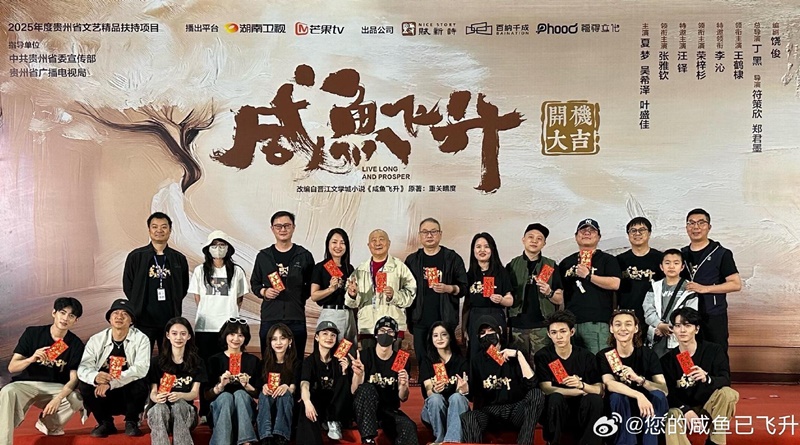
One of the things I was always interested in when I first started following and then writing about Chinese dramas was the red envelopes that you see almost every actor holding during a C-drama booting ceremony — the official event that kicks off the drama’s shooting schedule.
I always wondered what the purpose of the envelopes really was, did they always hold money and, if so, how much, and was there some kind of superstition attached to them?
Now, years later, and with a lot more research under my belt about C-dramas and their production, here is everything I know about the red envelopes at C-drama booting ceremonies.
Just in case you have the same questions I once did.
Why are red envelopes given to actors/crew at Chinese drama booting ceremonies?
First of all, the red envelopes (generally known as hóngbāo or 红包) at Chinese drama booting ceremonies (开机仪式 or kāijī yíshì) come from thousands of years of Chinese tradition and superstition.
1. Does everyone get one?
Yes, usually. At the start of filming (the booting ceremony), the producers/distributors give red envelopes to all members of the cast and crew. That means not just lead actors, but supporting actors, guest actors, directors, camera team, makeup staff, lighting, drivers, etc.
The idea of the red envelope is to wish everyone involved in the C-drama’s production safety, good luck, and a smooth production.
Remember though, it’s a gesture of blessing, and not a bonus or salary. The amounts are also very modest for most crew members (e.g., ¥6, ¥8, ¥66, ¥88 (around $13 being the highest amount), which are all thought of as lucky numbers by the Chinese), though key actors may receive larger sums.
In other words, being given a red envelope at a C-drama booting ceremony might buy you lunch, but it certainly won’t make you rich.
2. Does the red envelope always have money inside?
Yes, the red envelopes handed out at C-drama booting ceremonies usually have cash inside them. If they don’t, the person receiving the envelope will have a symbolic token inside theirs.
Most common: real money, but a small amount (lucky numbers like 6, 8, or 66, 88, 99).
Rarely: a check
Also possible although not common: a coin or a “lucky note” from a temple, though cash is the norm for booting ceremonies.
As far as the meaning of the red envelope goes, the red color wards off bad spirits, and the money symbolizes prosperity and warding off poverty/misfortune during the shoot.
Now you know why almost every actor/crew member has their photographs taken holding red envelopes and smiling. After all, they are all but guaranteed a successful shooting schedule, right?

3. Extra red envelopes for actors whose characters die in the drama?
Another rumor I had heard was that the actors whose characters will die in a drama get an extra envelope. And yes, this is a very real and well-known tradition in the Chinese film/TV industry.
If an actor’s character dies in the story, they are given an additional red envelope, often called a “death envelope” (去世红包 qùshì hóngbāo) or “all-purpose red envelope” and it’s given with the purpose of dispelling bad luck.
Why are these second red envelopes distributed?
In China, portraying death on screen is considered inauspicious as it might invite real-life bad luck or attract death energy to the actor playing the character who dies.
That’s why an actor whose character dies will usually receive an extra red envelope as it symbolizes three things:
- “Buying off” the bad luck, so it doesn’t happen.
- Thanking the actor for taking on this ill-omened role.
- Warding off actual harm.
How much does an actor whose character dies get?
Again, it’s usually a very small amount — ¥6, ¥8, or ¥10 — as the purpose of a second envelope is not for the actor to make out like a bandit, but instead it’s just a gesture that shows the production company/everyone involved in the production appreciate them “taking one for the team” as it were.
When does the actor with the soon-to-be deceased character get his/her second envelope?
That second envelope is almost always given separate from the booting ceremony envelope as well.
Instead, the second red envelope is often given on the day the death scene is filmed, or wrapped into the contract quietly.
Some productions do include it in the booting ceremony envelopes for transparency i.e., the actor receives a standard booting envelope, plus a separate “death” envelope if their character is known to die but, in most cases, they are more likely to be given it on the day they film the death scene.
4. Are there variations?
Yes, on the set of C-dramas, just like in daily life, there are variations:
- Some productions give two envelopes at booting if a major character dies — one normal luck, one “death offset” envelope.
- In smaller productions, it might just be a verbal agreement or a small gift.
- For extras playing corpses (e.g., in war dramas), they sometimes get a red envelope too, even if it’s sometimes just a few yuan.
- There have even been instances of certain actors (Yang Yang is one of them) handing out lucky red envelopes to fans who were at the booting ceremony to support the production.
5. What about the director and crew for death scenes?
No, only the actor playing the deceased character gets the extra envelope. The crew will usually receive a general luck envelope at booting, but not a death-specific one, as the bad luck is not thought to transfer to them, only to the actor playing the soon-to-be deceased.
A final cultural note
And, just in case you think the awarding of red envelopes is about “greed” (although, as I explained, the amount given is incredibly small, so it’s not like it could be), it’s not.
It’s about something called apotropaic magic, which is a specific type of magic used to ward off harm or evil, and something the Chinese believe strongly in.
Chinese set culture also takes so-called “unlucky” actions (saying certain words on set, filming death, breaking a mirror on set etc) very seriously. Just like western stage actors do when they will say “break a leg” rather than “Good luck” before a stage performance begins.
Both cultures have similar superstitions, they are just dealt with in different ways.
The red envelope given at Chinese booting ceremonies then is a practical, kind way to neutralize any bad luck that may occur during production while thanking the actor for their professional risk.
So next time you see a C-drama behind-the-scenes clip where they hand out red envelopes at the incense-burning ceremony, now you know why they are given and that there may be a second one quietly waiting for the actors who won’t make it to the finale.
About the Author