

Since I became obsessed with Chinese dramas many many years ago, it’s been obvious to me most fans of the genre are very likely women.
I see that in forums dedicated to C-dramas where posts by men are few and far between. I see it on review sites where reviews left skew overwhelmingly towards women, and I see it just from the idol dramas/romance dramas that become bigger than almost any other genre released. (Women are generally more interested in romance themes than men. Shocker, isn’t it?).
My assumption then has always been that women watch C-dramas in much higher numbers than men and, in some cases (depending on genre), are most of the audience.
With this in mind, I decided to do a little research about the demographics of C-drama fans in China, but primarily looking at males versus females.
After all, just because you assume something, it doesn’t always make it correct, and it’s always good to check.
As it turns out, I wasn’t.

Do more women than men watch C-dramas in China?
I specifically looked at the C-drama audience demographics in China as it’s easier to find data in the Chinese market, and it’s also very likely the male versus female demographics will be pretty consistent worldwide. Here then is what I found out.
For Chinese C-dramas (especially online dramas), as I had assumed, the audience is generally female-dominated, but the gender ratio still varies significantly depending on the genre of the drama in question.
iQiYI, for instance, has released stats showing their audience is 58% women and 42% men. That difference becomes even more prominent when you look at iQIYI’s most popular dramas, where women are 64% of the audience while male viewers have now decreased to 36%.
Overall, taking this and other similar information into account, female viewers account for approximately 60%–70% of the C-drama audience in China, while males account for approximately 30%–40%.
Overall and Genre-Specific Data of C-drama watching based on gender
According to Yunhe Data’s report for the first half of 2025, among users of newly released exclusive dramas on major platforms like iQiyi, Mango TV, Tencent Video and YOUKU, females account for an average of 61.4%–72.7%, with an average age of 31 years old.
So yep, younger women as well.
Ancient Idol Dramas: As you might expect with the majority of ancient idol dramas featuring male leads, this genre has the most skewed gender ratio, with women often reaching 70%–80% or even higher. For example, the female viewership proportion of some ancient romance dramas can reach over 85%.
“Male-Oriented” Themes (such as period drama/power struggles): Now this one is one of the more unexpected pieces of data. For me, at least.
It seems, although it was originally thought to be male-dominated, the reality of the viewership of “male-oriented” themed C-dramas is actually quite the opposite.
Take the smash-hit The Legend of Zang Hai as an example, the male-to-female ratio is actually 2:8 (males 20%, females 80%). C-drama classics Nirvana in Fire, War of Faith and Joy of Life also have female viewership exceeding 50%–60%.

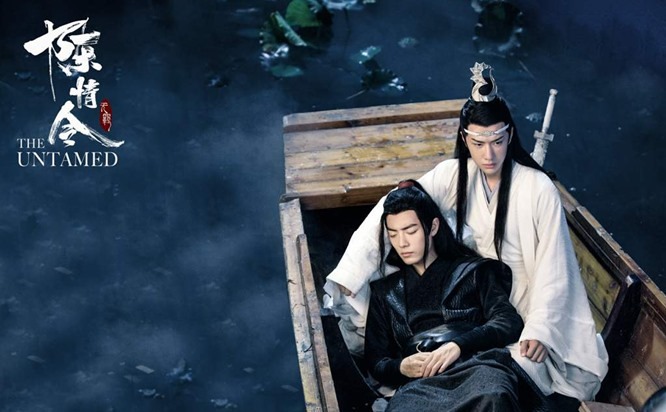
Of course, when you look at the cast list, though, The Legend of Zang Hai stars Chinese actor Xiao Zhan. A man who earned almost cult-like status after he starred alongside Wang Yi Bo in the definitive cult-classic drama The Untamed.
RELATED: What are the Chinese bromance dramas you definitely shouldn’t miss?
Joy of Life was also the first drama released featuring Xiao Zhan after the enormous success of The Untamed, as female fans were desperate to see him more and more and more.
The hit drama also stars Zhang Ruo Yun, who is a male heartthrob in his own right.
Meanwhile, War of Faith stars Xiao Zhang’s The Untamed co-star Wang Yi Bo, another cult idol actor since the success of that drama, with War of Faith managing to earn an almost 50/50 split when it released in 2024, with the audience being made up of 51 percent male and 49 percent female.
If the political-themed drama had not starred Wang Yi Bo, due to subject matter alone, my guess is it would have had a higher male audience ratio than female, as political dramas, especially those based in 1930s China, are not often women’s favorite genre.
As for Nirvana in Fire, it is one of the C-dramas any fan should have under their belt, and also stars popular male actors Hu Ge, Wang Kai, Victor Huang, and Chen Long alongside an equally star-studded cast.
So, to some extent, yes “male-oriented” themed dramas are also popular with women. But isn’t that more due to the hot men in them, than the subject matter?
Exceptions to the Female versus Male-dominated audience of C-dramas
It does turn out, however, that there is an exception where men versus women are the predominant audience for C-dramas. Not in all cases, but in many.
And this tends to be with crime dramas, and action and suspense C-dramas, where there is usually a significantly higher male viewership.
Even then, though, it’s still usually around a 50/50 gender balance, so women are showing up in droves for those as well.
In other words then, my years-long assumption that women are the predominant viewers of Chinese dramas has been born out with facts showing that, in simple terms, apart from a very small number of exclusively male-oriented themes, women are currently the absolute mainstay of C-drama viewership.
And sure, I could be wrong, but I have a feeling that is likely to continue, don’t you?
About the Author